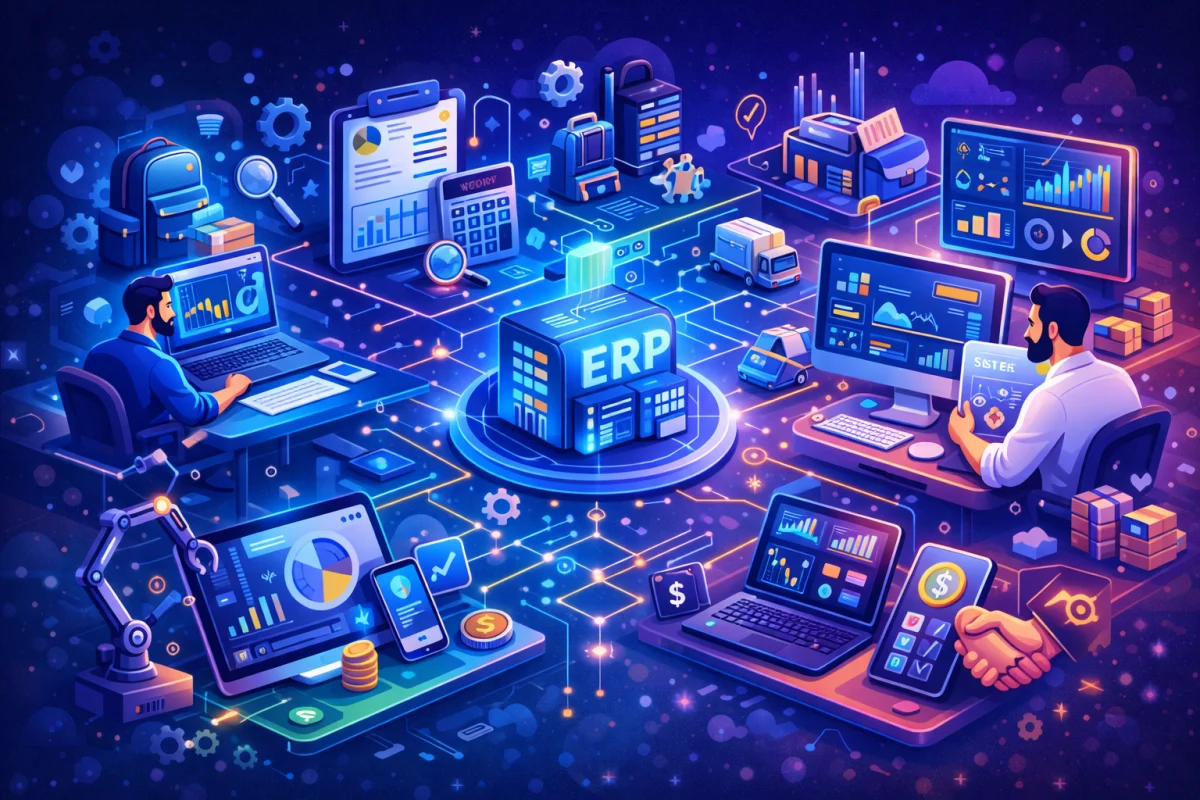
In today’s hyperconnected and data-driven economy, businesses no longer operate in isolated departments. Finance, operations, supply chain, human resources, sales, and customer management are deeply interdependent. As complexity grows, so does the need for unified control. At the core of this operational intelligence stands Enterprise Resource Planning (ERP)—the backbone of the modern digital enterprise.
Traditionally, ERP systems were introduced to centralize data and standardize processes. They replaced fragmented spreadsheets and disconnected tools with integrated workflows. While this consolidation improved efficiency, modern business demands far more than centralization. Today, ERP is evolving from a record-keeping system into a strategic decision engine.
The contemporary ERP platform functions as a real-time operational command center. Every transaction—inventory movement, financial entry, procurement update, payroll adjustment—feeds into a unified data ecosystem. This centralized architecture eliminates data silos and ensures that leadership decisions are based on consistent, accurate, and synchronized information.
From a technical perspective, modern ERP systems are increasingly built on cloud-native architectures with modular microservices. APIs enable seamless integration with POS systems, e-commerce platforms, CRM tools, and third-party SaaS products. Data pipelines process transactional streams continuously, while analytics engines transform raw operational data into actionable intelligence.
The integration of Artificial Intelligence is further redefining ERP capabilities. Machine learning models can forecast demand, optimize inventory levels, detect financial anomalies, and predict cash flow trends. AI-driven automation can manage procurement cycles, flag compliance risks, and recommend operational adjustments before bottlenecks occur. ERP is no longer reactive—it is becoming predictive and adaptive.
For growing organizations and startups, ERP implementation is no longer a luxury reserved for large enterprises. In competitive markets, operational inefficiency translates directly into lost revenue. Scalable ERP systems provide visibility, accountability, and process discipline from the early stages of growth. They allow companies to expand without losing structural control.
Moreover, in an era defined by global collaboration, remote operations, and digital supply chains, real-time synchronization is essential. Cloud-based ERP platforms enable distributed teams to operate within a unified system regardless of geographic location. This interconnectedness enhances transparency, accelerates decision cycles, and reduces operational risk.
However, deploying ERP effectively requires thoughtful engineering. Customization must balance flexibility with maintainability. Data governance frameworks must ensure integrity and security. Integration layers must be carefully designed to prevent system fragmentation. As ERP becomes more intelligent, explainability and auditability become critical for compliance and trust.
The importance of ERP today extends beyond efficiency—it defines resilience. Organizations with integrated and intelligent ERP infrastructures can adapt faster to market disruptions, supply chain volatility, and regulatory changes. They gain not only operational clarity but strategic agility.
We are entering an era where businesses are measured by how intelligently they operate. ERP systems are no longer back-office utilities; they are the structural foundation of digital transformation. When combined with analytics, automation, and AI, ERP evolves into an enterprise nervous system—continuously sensing, processing, and guiding organizational movement.
In the modern economy, sustainable growth depends on structured intelligence. And at the center of that intelligence stands ERP—powering clarity, coordination, and confident decision-making in an increasingly complex world.